Introduction
Construction and building maintenance projects often require safe access to elevated exterior surfaces. Painting, facade cleaning, repair, waterproofing, window maintenance, and installation work may require workers to operate at considerable heights.
Two commonly considered access solutions are hanging platform gondolas and traditional scaffolding.
Both have their applications, but they differ significantly in installation, mobility, space requirements, and suitability for different buildings.
Understanding these differences can help contractors and project managers select the appropriate solution.
What Is a Hanging Platform Gondola?
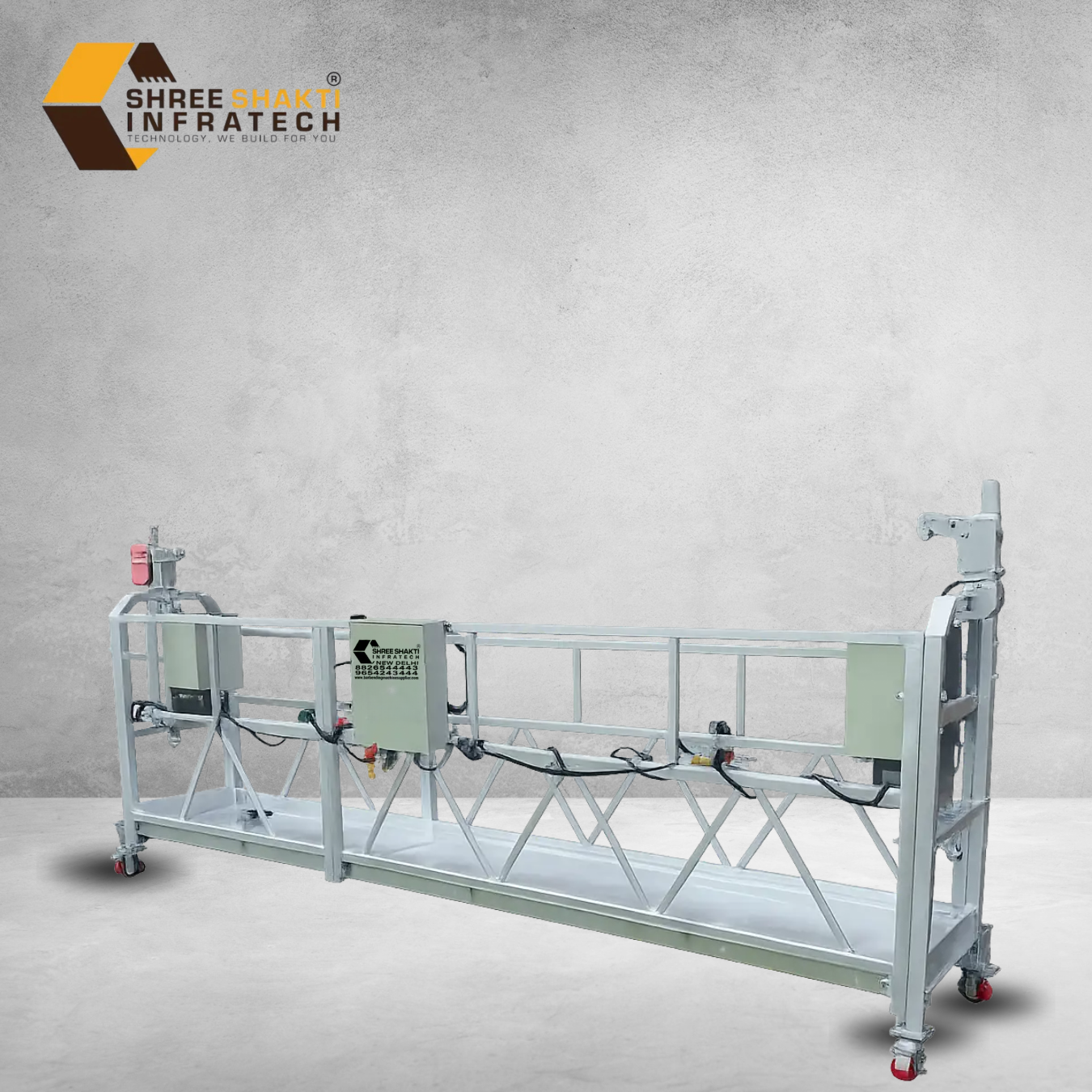
A hanging platform gondola, also known as a suspended platform, is a work platform suspended from the roof or another suitable supporting structure using wire ropes and hoists.
The platform can generally be raised or lowered along the building facade.
It is commonly considered for:
- High-rise building maintenance
- Exterior painting
- Facade cleaning
- Window cleaning
- Repair work
- Waterproofing
- Building inspection
Its ability to move vertically makes it particularly useful for tall structures.
What Is Traditional Scaffolding?
Traditional scaffolding is a temporary structure assembled from tubes, frames, boards, or modular components.
It provides a stable working platform at different heights and can be used for:
- Construction
- Plastering
- Painting
- Masonry
- Repair work
- Building finishing
Scaffolding is generally assembled from the ground upward, although the exact arrangement depends on the building and system used.
Hanging Gondola vs Traditional Scaffolding
| Feature | Hanging Platform Gondola | Traditional Scaffolding |
|---|---|---|
| Installation | Suspended from suitable support | Generally assembled from ground level |
| Vertical Movement | Powered/manual depending on system | Requires access between scaffold levels |
| Ground Space | Relatively limited | Can require significant ground area |
| High-Rise Use | Particularly suitable | Possible but requires extensive assembly |
| Mobility | Moves vertically along facade | Fixed until dismantled/reconfigured |
| Setup | Generally faster for suitable buildings | Can require significant assembly |
| Storage | Compact compared with large scaffold systems | Requires multiple components |
| Best For | Facade access and maintenance | Construction and multi-level work |
1. Installation Time
Traditional scaffolding can require considerable time to assemble, especially for tall buildings and large structures.
A hanging platform gondola can often be installed with a suitable suspension arrangement and then moved vertically along the facade.
This can make suspended platforms attractive for projects where frequent facade access is required.
However, installation time depends on building design, roof conditions, equipment configuration, and site requirements.
2. Working at Greater Heights
High-rise buildings can present challenges for traditional scaffolding.
As building height increases, scaffolding typically requires additional structural components, bracing, access arrangements, and installation work.
A suspended gondola can provide vertical access from a suitable overhead suspension system, making it particularly useful for high-rise facade maintenance.
The building’s structural and suspension requirements must always be assessed before installation.
3. Ground-Space Requirements
Traditional scaffolding generally occupies space around the building.
This can be challenging where the ground area is:
- Limited
- Crowded
- Used for vehicle movement
- Adjacent to roads
- Occupied by landscaping
- Required for other construction activities
A hanging platform operates above ground level, potentially reducing the amount of ground space needed for facade access.
4. Vertical Mobility
One of the biggest advantages of a hanging gondola is its vertical movement.
Workers can move the platform upward or downward to reach different sections of a building.
With traditional scaffolding, workers normally access different levels using the scaffold’s built-in access arrangements.
For repeated facade movement, a suspended platform can provide greater operational flexibility.
5. Productivity
Productivity depends on the type of work being performed.
For facade cleaning, painting, inspection, and maintenance, a suspended platform can allow workers to move along the building elevation without dismantling and rebuilding access structures.
Traditional scaffolding can provide a broader fixed work area and may be preferable when workers need to perform extensive construction activities from a stable platform at multiple levels.
6. Flexibility
Hanging gondolas are particularly useful for work that involves moving vertically along a facade.
Traditional scaffolding can provide greater flexibility for construction work where workers need access to multiple horizontal and vertical areas simultaneously.
Therefore, the choice should be based on whether the project primarily requires mobile facade access or fixed multi-level working platforms.
7. Project Type Matters
Hanging Platform Gondola
Often considered for:
- Facade cleaning
- Exterior painting
- Window cleaning
- Building maintenance
- Inspection
- Repairs
- Waterproofing
Traditional Scaffolding
Often considered for:
- Brickwork
- Plastering
- Masonry
- Structural construction
- Building finishing
- Extensive multi-level construction work
Some projects may even use both systems at different stages.
8. Cost Considerations
The cost comparison depends on:
- Building height
- Project duration
- Labour requirements
- Installation time
- Equipment rental or purchase
- Transportation
- Maintenance
- Site conditions
Traditional scaffolding can involve significant labour and material requirements for assembly and dismantling.
A suspended platform may reduce some access-related labour for suitable applications, but it requires appropriate suspension equipment, hoists, safety systems, and installation.
Therefore, businesses should compare total project costs rather than equipment purchase prices alone.
9. Safety Requirements
Both systems require proper planning, installation, inspection, and operation.
For suspended platforms, important considerations include:
- Rated load
- Suspension system
- Wire ropes
- Hoists
- Guardrails
- Safety devices
- Emergency systems
- Building support structure
For scaffolding, considerations include:
- Structural stability
- Bracing
- Platforms
- Guardrails
- Access
- Load capacity
- Foundation and support
All work-at-height equipment should comply with applicable regulations and manufacturer instructions.
10. Choosing the Right Solution
A hanging platform gondola may be the better choice when:
- The project involves high-rise facade access
- Frequent vertical movement is required
- Ground space is limited
- The primary work is maintenance or finishing
- Quick repositioning is important
Traditional scaffolding may be more suitable when:
- Workers need broad fixed platforms
- Masonry or structural work is involved
- Multiple levels require simultaneous access
- Materials need to be stored or handled on working platforms
Why Choose an Experienced Suspended Platform Manufacturer?
Selecting the right manufacturer is important when purchasing a hanging platform gondola.
Buyers should evaluate:
- Platform design
- Load capacity
- Hoist quality
- Wire-rope specifications
- Safety systems
- Material quality
- Customization options
- Inspection and testing
- Spare-parts availability
- Technical support
Shree Shakti Infratech can be evaluated based on the specific gondola model, technical specifications, safety provisions, and project requirements.
Quick Decision Guide
| Project Requirement | Recommended Option |
| High-rise facade cleaning | Hanging gondola |
| Exterior building painting | Hanging gondola |
| Window cleaning | Hanging gondola |
| Building inspection | Hanging gondola |
| Masonry work | Traditional scaffolding |
| Plastering | Traditional scaffolding |
| Large fixed work area | Traditional scaffolding |
| Multi-level structural work | Traditional scaffolding |
Conclusion
Hanging platform gondolas and traditional scaffolding serve different purposes.
A gondola is particularly useful for high-rise facade access, painting, cleaning, inspection, and maintenance, where vertical mobility and reduced ground space requirements are valuable.
Traditional scaffolding may be better suited to construction activities requiring broad, fixed, multi-level working platforms, such as masonry and plastering.
The best choice depends on the building design, work type, height, project duration, site conditions, load requirements, and safety provisions.
For businesses considering a suspended gondola, selecting an experienced Suspended Platform Manufacturer and verifying the equipment’s specifications, safety systems, installation requirements, and support services should be an essential part of the purchasing process.